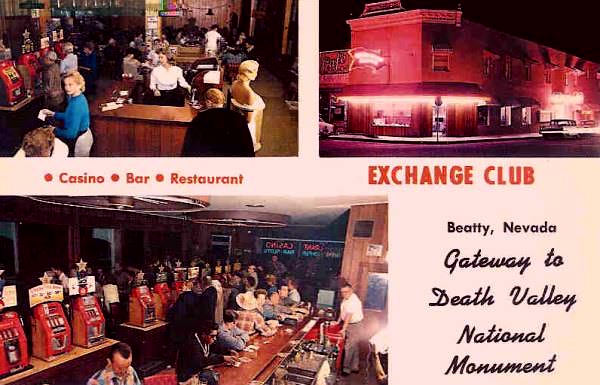
Photo from the Mark Englebretson Collection
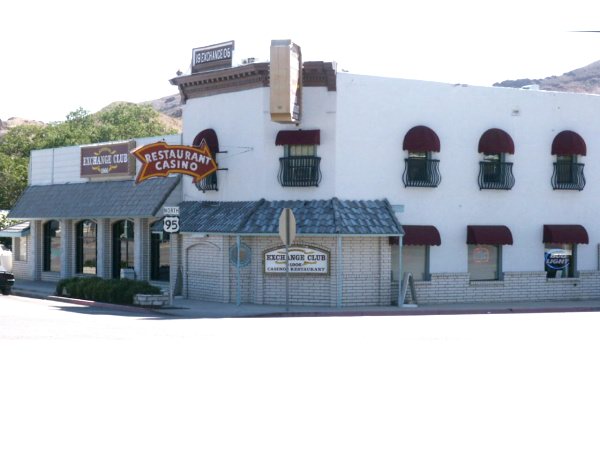
Photo from the Mark Englebretson Collection
| Exchange Club |
| 604 Main Street |
| est. 1954 |
Photo from the Mark Englebretson Collection |
Photo from the Mark Englebretson Collection |
) Louie Eliopoulos Grade 3 |
) Mark Englebretson Grade 2 |
) Richard & Bev Siri Grade 2 |
) John Rauzy Grade 2 |
) John Rauzy Grade 2 |
) Mark Englebretson Grade 2 |
) Laurence Miller Grade 3 |
) Howdy Herz Grade 2 |
Gambling on Beatty. A History of the Exchange Club by Howard W. Herz The Exchange Club If you are driving along highway 95 from Tonopah to Las Vegas you will find an oasis in the desert that has served travelers, miners and the military for more than a century. Tucked between hills that are colored with mineral deposits, the town of Beatty Nevada has served as a rail depot, mining center and recreation hot spot for the Nevada test site. Founded around the turn of the century, Beatty has survived the economic roller coaster of a century of boom and bust. Beginning as an offshoot of the mining boom that started with Rhyloite in the Bullfrog mining district Beatty survived the end of the first Rallied boom by being on the Las Vegas & Tonopah railroad. As a rest stop on highway 95 between Tonopah and Las Vegas the town also served as a critical stop for travelers. When Nevada legalized gambling in 1st Issue &100 chip around 1955. The chip came in two different colors. 1931, most of the action was in Tonopah where a number of casinos licensed a full list of games. Most of the other gaming in the county was slot machines in bars and a sprinkling of poker games. Located on a critical corner of highway 95 in the center of town where the road turns from east-west to south, the Exchange Club sits on the southeast corner of the intersection. Clearly, an historic building, the parapet at the top of the corner reads 19 EXCHANGE 06. In the era of modern gaming the official history of the club begins with an entry in the Nye County official records for October, 1939 when a cigarette license was granted to the Exchange Bar. From 1940 to 1944 the Exchange Bar was operated by Roena L. McLean with occasional licenses for liquor, cigarettes and slots. In October of 1944 the Exchange Bar was operated by Louis Hinds who continued to have slots until 1946 when he was licensed for a crap game, the first live gaming for the Exchange. Hinds continued operations until April of 1951 when a license was granted to a Mr. Eldridge for roulette, slots and blackjack. Starting in January of 1952, the licenses were issued to the Exchange Bar & Casino for liquor, slots and roulette. It is this era of ownership that produced the first issue of gaming checks that we have been able to document. The only issue that we have found is the $100 check on the mold of the Salt Lake Card Co. featuring concentric circles. In 1955 the Exchange Bar & Casino was sold to Warren Doing. The name was changed back to the Exchange Bar and was licensed to O. W. Glenn and Warren Doing. As an experienced gaming operator from California, Warren Doing sought the expertise of his friend Murphy Breedlove who had been dealing poker in Westlake California. For five years Breedlove and Doing operated the Exchange Bar with craps, roulette, poker and blackjack as well as 26 slot machines. Their operation of the casino would continue until 1960 when the migration of a family from Wyoming would change the face of the Exchange. In the 1950's Kenneth (Nick) and Lawrence (Larry) Knight operated the Emery Hotel & Bar in Thermopolis, Wyoming. With gambling a county option in Wyoming, they had poker tables and slot machines. When they sold the bar in 1960, they began an odessy through Nevada looking for a suitable gaming operation that would suit their taste. As Nick's son Peter Knight recalls, they traversed almost every road in the state of Nevada until one day when they found the Exchange Bar in Beatty. Trained in gambling and looking for a family operation, the Exchange fit the bill. Unable to buy the bar from Warren Doing, they negotiated a 20 year lease of the building and the Exchange Club was off to a new start. In the 4th quarter of 1960 Kenneth E. Knight, Fay B. Knight, Larry M. Knight and Elaine K. Knight began the restoration of the bar. The original adobe building needed restoration so the Knights had the exterior covered with gunite. They would eventually ad a basement to the building as well as converting the upstairs hotel rooms to quarters for the employees. There was little doubt about what the decor of the club would be. With Nick Knight, a member of the Cowboy hall of fame, and the rest of the family steeped in western tradition, the club's original historical bar and tin ceiling were preserved. With wagon wheel chandeliers featuring a tasteful touch of neon, a gaggle of Mills slots, a craps table and a historical bar from Rhyolite rounded out the decor. Starting out with their experience from Wyoming, the Knights sought to have a local clientele that would get personal service and care. They knew that in Las Vegas a player could drop $5,000 and hardly be noticed. "At the Exchange Club, we tried to know all of our customers and let them know that we cared." says Elaine Knight. Besides being the largest club in Beatty, The Exchange Club served as a center for business in the community. Without a bank, most of the local businesses sought to keep cash circulating in the town. Even the houses of prostitution would bring their cash to the casino and exchange it for checks that they would mail to their banks. The Club served as one of the major social institutions of Beatty featuring dances and other events for the locals. The Knights joined the local Lions Club in supporting burro races for the amusement and entertainment of the local population. This event mushroomed into a major state and national event that eventually became so unwieldy that the races had to be cancelled. Larry dealt blackjack while Faye and Elaine and Nick managed the operation. With patience and determination, the Knight family developed the Exchange Club into a local institution. With a clientele of tourists, locals and workers from the Nevada Test Site at Mercury, the Exchange Club prospered. It was a lot of hard work and determination, but it was paying off. Out in the middle of Nevada there was little of the supervision from the Nevada Gaming authorities that is found today. Crossroaders (cheats) came and went and the house had to provide its own security and surveillance. Experience counted more than anything in keeping the games honest and the customers in line when necessary. Larry Knight had never let his wife Elaine deal because he felt that customers were at their best and worst when playing and he did not want her to have to deal with them at their worst. One evening while supervising, Elaine heard Larry say "don't do that" to a customer. A minute later she again heard "DON'T DO THAT". The customer persisted and Elaine watched while Larry put the dealers deck down, walked away from the table to a slot mechanics stand and picked up a balpeen hammer. He walked back to the table and bonked the player on the head with the hammer. He walked back to the slot mechanics tools, replaced the hammer and returned to deal the game-to the same customer. Elaine never knew for certain what the customer was doing, but "Larry fixed it-even with a hammer!" Characters, both local and transient, were a common sight in the Exchange. There was the poodle named Farley that would drink out of a soda bottle with a straw up at the bar. There were always reasons to party and Peter Knight's (Nick's son) 21st birthday was no exception. There was the sign that said "Be Alert" and nobody was sure what it meant. Customers and owners partied together. The employees lived upstairs in the converted hotel rooms and were frequently the source of amusement and problems. Elaine Knight remembers one evening when she needed the help of one of the "swampers" and sent another employee up to fetch him. Finding the "swamper" sitting on the edge of his bed with an empty wine bottle by his side, the employee stated "Elaine wants you". The "swamper", feeling no pain, stared for a moment and then replied "tell her I am flattered". The Knight family suffered a set back in 1966 when owners Faye and Nick Knight were killed in a plane crash. Missing a critical part of their operations team, Elaine and Larry Knight carried on and brought Nick's son Peter onto the license. By the 1970's The Exchange Club was typical of a western Nevada casino in the era before mega corporations began to dominate the Nevada gaming scene. The Exchange Club name was the source of some concern to a group of lawyers in the 1970's. Peter Knight received a letter from the Exchange Club International, a national service club, demanding that they cease and desist using the name. Claiming that a number of their members had stopped at the club thinking that it was associated with their service club, they demanded that the Knight family change the name. Peter Knight ignored the letter. When another letter followed with a similar demand on the stationary of a Philadelphia law firm Peter acted. Recalling his legal classes at Stanford law school, Peter took his Polaroid camera and shot a picture of the 19EXCHANGE 06 lettering on the front of the club. With a letter suggesting that in fact the Exchange Club International was violating their name, Peter's attached photograph seemed to settle the issue. In 1966 with the demise of the silver dollars, the Knight's ordered dollar gaming tokens for the Exchange Club. Taking a liberty with the currency, the tokens value was stated as a "Burro Buck". In 1979 when tokens were again put into use after the Eisenhower dollars were pulled from circulation, the term "Burro Buck" did not meet the regulations of the gaming control board. In an attempt to utilize the older tokens, a number of them were engraved with the correct terminology "Dollar Gaming Token". Starting with an engraving machine for the wording, the Knight's soon found that the process was far too time consuming. Using a vibrating engraver, they had a number of tokens hand engraved with the wording. In one instance the engraver put his initials on the token, an act of pride in workmanship in what had to be a very boring and tedious job. In June of 1980, the Knight's lease on the Exchange Club ended and a combination ownership of Warren Doing, Murphy Bredlove and Bill Boyd took over the operation. The Knight's took a short vacation after 20 years of hard work. Murphy Breedlove was the operating partner in Beatty while Warren Doing operated the Searchlight Nugget and Bill Boyd lived in Las Vegas. Keeping the traditions that the Exchange Club had developed under the Knight's, The Exchange Club was essentially Beatty's bank for local businesses, a practice that gaming control would not condone today. Although the Burro races had been abandoned in the 1970's, Breedlove recalls town dances that lasted until the wee hours of the morning. "We would party until the sheriff called around 5am-about the same time most of the locals went home." says Maxine Breedlove. They were great parties and everyone in town would come. Breedlove and his partners were the first to put the new electronic poker machines in the Exchange Club and they were an instant hit. The club continued to thrive until misfortune struck on April fools day in the early 1980's. One of the employees rooming in the second floor hotel rooms put a blanket over a heater and the resulting fire closed the club for repairs. Having to almost totally rebuild the interior, the Exchange Club was closed for months of repairs. Along with building upgrades, the owners installed air conditioning, a modernizing necessity, but one that covered the tin ceiling of the original bar. The restaurant was remodeled and the club re-opened. The clientele of the 1980's had shifted as the MX missile system proposal brought engineers and military supervisors to the area. The traffic from the Nevada test site at Mercury continued to boost the Beatty economy. As more and more accidents occurred on highway 95 between Mercury and Beatty, the highway was nick-named the widow maker. The military clientele became the basis of one of the most memorable evenings for Murphy Breedlove. "Almost all of our customers were military or ex-military at that time. All of them probably had basic training at some time in their lives. One evening a local character by the name of "Gooch" walked into the club with a hand grenade. The place was packed and he walked into the center of the bar and let the thing go. The pin flew up in the air and the grenade tumbled out of his hands. Gooch dove on the grenade, but not before all of our customers had fled the casino. I think it took most of them less than 3 seconds to run out the doors. The bartender went out from behind the bar and took the swinging door with him. Of course the grenade turned out to be a dud, but all of those military types didn't stay around to find out." "There was the time that someone dropped a couple of rattle snakes on the poker table and a few things like that but most of the time we had a good time without too many problems-except for April fools,-everything bad happened on April fools" says Murphy. In the 1980's the club had to provide its own security from crossroaders. Having been in the business for more than 30 years, Murphy knew most of the crooks and scam artists that would come in. Murphy's wife Maxine recalls one crossroader who drifted in one evening. Maxine saddled up alongside the man and commented "I understand its nice outside, you ought to go out and get some fresh air." The crossroader got the message and departed. With the surge in mining in Rhyolite, The Exchange Club again prospered through the 1980's. The 1990's brought a slow down in the mining and the club has again seen lean times. Murphy Breedlove has retired and left the operation of the casino to his daughter Tabby Mulryan. The future of the gaming business in Beatty continues to be a gamble. Indian casinos in California have cut into the customer base, but tourism has increased. The Exchange Club still caters to locals, offers good food and provides clean modern motel rooms next door to its club. With gaming booming in Las Vegas and Nevada continuing to be the fastest growing state the next chapter in the history of the Exchange Club has yet to be written. First published in the Casino Chip and Token News Magazine, Volume 18, Spring 2005 issue. Casino Chip and Tokens News is the official publication of The Casino Chip and Gaming Token Collectors Club, Inc. Special Permission was granted to reprint this information. All rights are reserved by the CCGTCC. If interested in joining this fascinating collecting field and receiving the clubs award winning magazine, go to www.ccgtcc.com and select membership. |